The polymath blog

February 7, 2016

Polymath 11 is Now Open

Filed under: news — Gil Kalai @ 3:45 am

PF      PF2

Two great Peter Frankls

Tim Gowers launched polymath 11 aimed at Peter Frankl’s conjecture asserting that for every union-closed family there is an element that belongs to at lease half the sets in the family. Here are links to Post number 0 and Post number 1. (Meanwhile polymath10 continues to run on “Combinatorics and More.”)


Polymath Proposals on Math Overflow

Filed under: news,polymath proposals — Gil Kalai @ 3:21 am

mo


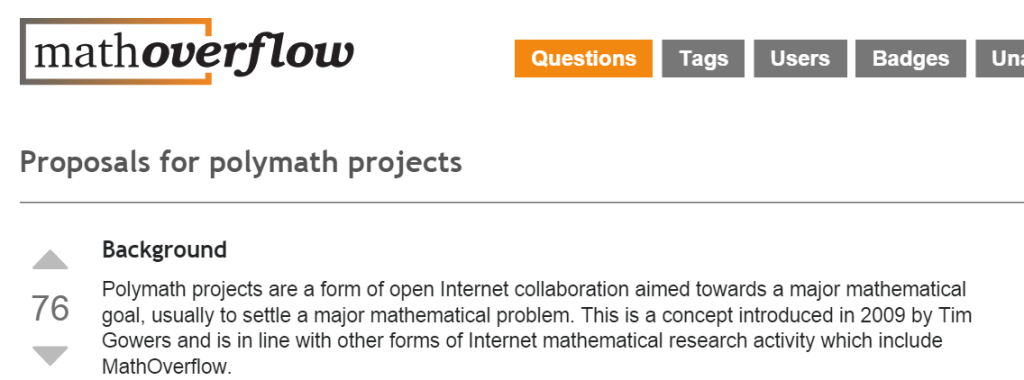
Here is the link to a mathoverflow question asking for polymath proposals. There are some very  interesting proposals. I am quite curious to see some proposals in applied mathematics, and various areas of geometry, algebra, analysis and logic.

Explaining Polynomials Identities – Success!

Filed under: news — Gil Kalai @ 3:03 am

Thakur_color_150x210                                              DavidSpeyerCasual

Dinesh Thakur                                                                David Speyer

A beautiful polymath proposal by Dinesh Thakur was posted  by Terry Tao on the this blog. The task was to explain some remarkable, numerically observed, identities involving the irreducible polynomials P in the polynomial ring {\bf F}_2[t] over the finite field of characteristic two. David Speyer managed to prove Thakur’s observed identities! Here is the draft of the paper. Congratulations to Dinesh and David!


November 6, 2015

Polymath10 is now open

Filed under: news — Gil Kalai @ 12:42 pm
Tags:

Sonnenblume_02_KMJ


Polymath10 has started on my blog. The aim is to prove the Erdos-Rado sunflower conjecture (also known as the delta-system conjecture).  Here is the wikipage.

September 22, 2015

The Erdős discrepancy problem has been solved by Terence Tao

Filed under: polymath5 — Gil Kalai @ 12:41 pm
Tags: ,

Polymath5 was devoted to the Erdős discrepancy problem. It ran in 2010 and there were a few additional posts in 2012, without reaching a solution. The problem has now been solved by Terry Tao using  some observations from the polymath project combined with important recent developments in analytic number theory. See this blog post  from Tao’s blog and this concluding blog post from Gowers’s blog.

January 20, 2014

Two polymath (of a sort) proposed projects

Filed under: discussion,polymath proposals — Gil Kalai @ 5:20 pm
Tags: , ,

This post is meant to propose and discuss a polymath project and a sort of polymath project.

I. A polymath proposal: Convex hulls of real algebraic varieties.

One of the interesting questions regarding the polymath endeavor was:

Can polymath be used to develop a theory/new area?

My idea is to have a project devoted to develop a theory of “convex hulls of real algebraic varieties”. The case where the varieties are simply a finite set of points is a well-developed area of mathematics – the theory of convex polytopes, but the general case was not studied much. I suppose that for such a project the first discussions will be devoted to raise questions/research directions. (And mention some works already done.)

In general (but perhaps more so for an open-ended project), I would like to see also polymath projects which are on longer time scale than existing ones but perhaps less intensive, and that people can “get in” or “spin-off” at will in various times.

II. A polymath-of-a-sort proposal: Statements about the Riemann Hypothesis

The Riemann hypothesis is arguably the most famous open question in mathematics. My view is that it is premature to try to attack the RH by a polymath project (but I am not an expert and, in any case, a project of this kind is better conducted with some specific program in mind). I propose something different. In a sort of polymath spirit the project I propose invite participants, especially professional mathematicians who thought about the RH over the years,  to share their thoughts about RH.

Ideally each comment will be

1) One or a few paragraphs long

2) Well-thought, focused and rather polished

A few comments by the same contributors are also welcome.

To make it clear, the thread I propose is not going to be a research thread and also not a place for further discussions beyond some clarifying questions. Rather it is going to be a platform for interested mathematician to make statements and expressed polished thoughts about RH. (Also, if adopted, maybe we will need a special name for such a thing.)

____________________

This thread is not launching any of the two suggested projects, but rather a place to discuss further these proposals. For the second project,  it will be better still if the person who runs it will be an expert in the area, and certainly not an ignorant. For the first project, maybe there are better ideas for areas/theories appropriate for polymathing.


November 4, 2013

Polymath9: P=NP? (The Discretized Borel Determinacy Approach)

Filed under: polymath proposals — Gil Kalai @ 2:07 pm
Tags: ,

p-np5

Tim Gowers Proposed and launched a new polymath proposal aimed at a certain approach he has for proving that NP \ne P.

September 20, 2013

Polymath8 – A Success !

Filed under: news — Gil Kalai @ 5:58 pm
Tags:

The main objectives of the polymath8 project, initiated by Terry Tao  back in June, were “to understand the recent breakthrough paper of Yitang Zhang establishing an infinite number of prime gaps bounded by a fixed constant {H}, and then to lower that value of {H} as much as possible.”

Polymath8 was a remarkable success! Within two months the best value of H that was 70,000,000 in Zhang’s proof was reduced to 5,414. Moreover, the polymath setting looked advantageous for this project, compared to traditional ways of doing mathematics. (I have written a post with some more details and thoughts about it, looked from a distance.)

March 2, 2013

Polymath proposal (Tim Gowers): Randomized Parallel Sorting Algorithm

Filed under: polymath proposals — Gil Kalai @ 4:41 pm

traj2

From Holroyd’s sorting networks picture gallery

A celebrated theorem of Ajtai, Komlos and Szemeredi describes a sorting network for  $n$ numbers of depth $O(log N)$. rounds where in each runs $n/2$. Tim Gowers proposes to find collectively a randomized sorting with the same properties.

February 14, 2013

Next Polymath Project(s): What, When, Where?

Filed under: polymath proposals — Gil Kalai @ 3:26 pm

wspolymath

Let us have a little discussion about it.

We may also discuss both general and specific open research mathematical projects which are of different flavor/rules.

Proposals for polymath projects appeared on this blog,  in this post on Gowers’s blog, and in several other places.

« Previous PageNext Page »

Blog at WordPress.com.